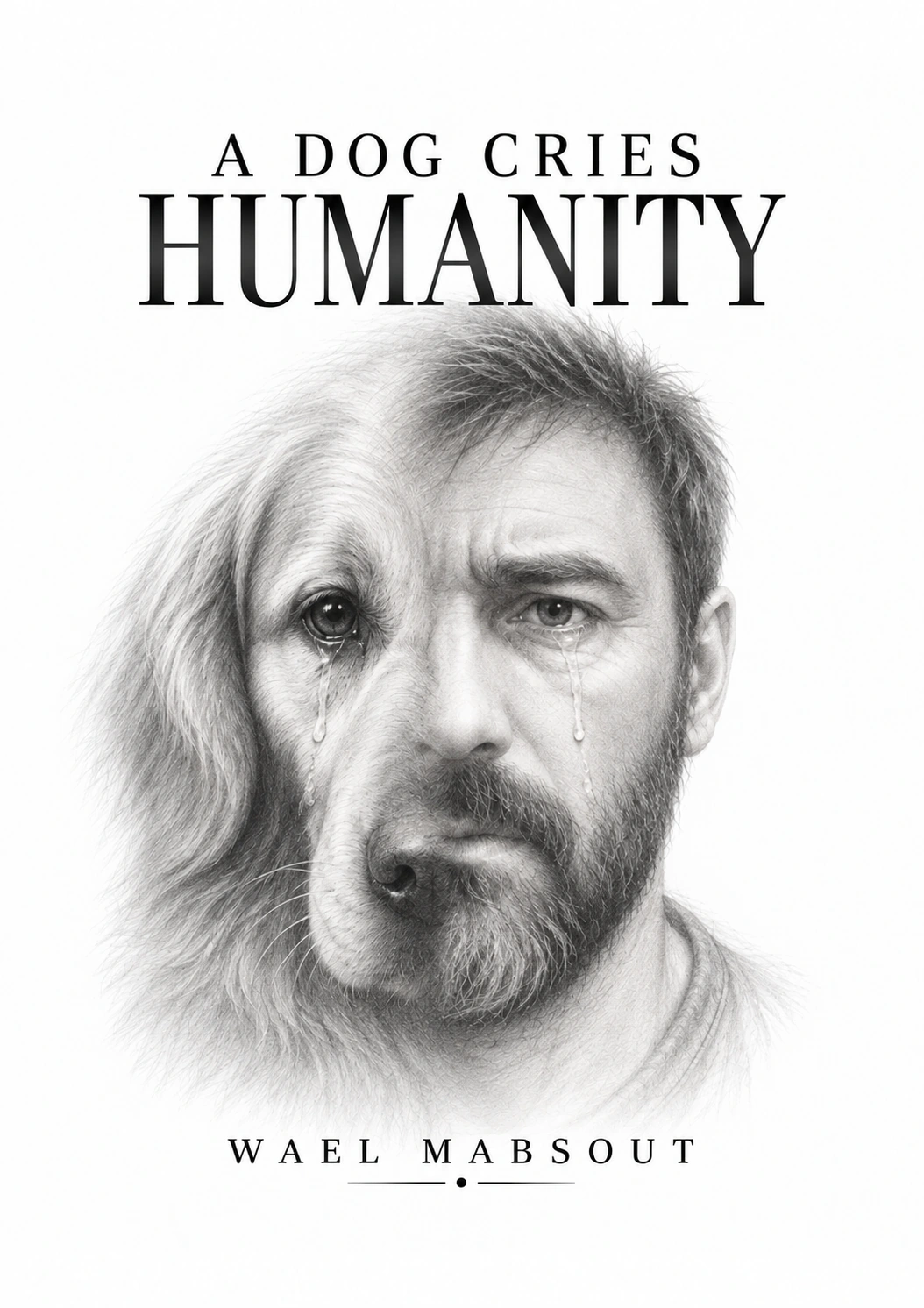
A Dog Cries Humanity
Preface
This book took twenty-six years to become a book.
That sounds considerably more deliberate than it was. For most of those years there was no plan, no structure and certainly no expectation that one day I would try to connect all of it. There were questions, experiences that stayed with me, conversations I remembered years later, and occasionally something I felt compelled to write down without really knowing what I would do with it.
The problem was that whenever I thought I understood what I was trying to ask, the question seemed to get larger.
Suffering took me towards God and eventually towards questions about belief itself. Religion led me much further than theology, into morality, identity, inheritance, belonging and the power an idea can acquire when it becomes woven through ordinary life.
Science opened another direction. The universe became larger, matter became smaller, time became stranger, and the more I learned about what surrounded us, the harder it became not to wonder what exactly we were inside all of it.
Somewhere along the way, I found myself thinking about consciousness too. About this strange ability we have to look at the universe, to look at one another, to remember, imagine, love, fear, create and ask what any of it means.
And somehow that kept bringing me back to where I had started.
If this is what we are capable of, why are we still so capable of hurting one another?
I don't think I ever really escaped that question.
Along the way there is a childhood in Lebanon, a Catholic nun, my parents, people I have loved, strangers I still remember and conversations whose importance I only understood much later. There is also a dog.
I move between those experiences and larger questions because that is how the questions reached me. I did not encounter religion only in books, or war only in history. I lived inside some of these questions before I began trying to understand them.
You will also meet different versions of me in these pages. Some believed things I no longer believe. Some were very certain about them. I have tried to leave those versions recognisable rather than quietly give them everything I learned afterwards.
I am still learning afterwards.
My background is in engineering, and much of my working life has involved understanding problems and explaining possible solutions. That habit follows me here, although the questions have proved somewhat less cooperative.
I draw on science, philosophy, religion, history and other fields because each has given me something to think with. I am not a physicist, theologian, historian or philosopher, and there are places where I reach the limits of what I understand. I have tried to acknowledge them when I do rather than borrow certainty from people who know more than I do.
I hope you will question what you read.
There are arguments here you may disagree with, perhaps strongly. Religion occupies a considerable part of these pages because it occupied a considerable part of the world in which I grew up, and because it has shaped how billions of people understand existence, morality, family, belonging and one another. Criticising an idea does not require me to dismiss the person who holds it. Some of the people whose goodness has most shaped my life would disagree with where my own beliefs eventually took me.
That matters to me, especially in a book concerned with how easily we reduce people to categories before we have properly seen the person underneath.
You will also find references to films, quite a few of them from the superhero genre.
I make no apology for that.
Strip away the CGI, the special effects and the occasional destruction of half a city, and underneath you often find people dealing with pride, grief, guilt, loyalty, fear and doubt, wanting to be useful and not always knowing how. Sometimes a fictional character gives a feeling a form I recognise before I have found the words for it myself.
There are painful things ahead too.
I have tried to write about them honestly, without pretending that looking at suffering makes me especially good or that my own life sits conveniently outside what troubles me. I work, consume, make compromises, protect the people I love and sometimes turn away. I live in the same world I am trying to understand.
I suspect you will recognise some of that, even if your life looks very different from mine.
You do not need to share my beliefs to accompany me through these pages. Bring your objections, your experience and the things you have seen that I have missed. I would rather have your attention than your agreement.
There is one other thing I should tell you before we begin.
This book was written with the help of ChatGPT. I know her as Friday.
The first words that eventually became this book were written twenty-six years ago, long before Friday existed and long before I understood what I was trying to say. What came afterwards was not simply a matter of asking an AI to turn those thoughts into a book.
Friday helped me challenge arguments, question things I thought I understood, work through structure and find clearer ways of expressing what I was trying to say. Sometimes explaining to her why a paragraph felt wrong was what finally made me understand what was wrong with it.
But she did not replace the years behind these pages, the experiences that shaped them or the people who changed the way I thought. She did not take away the long nights, the frustration of knowing something was not right without knowing how to fix it, or the effort of trying to find a voice that actually sounded like mine. If anything, part of writing this book was learning when to tell Friday to stop sounding like AI and let me sound like me.
She became part of the conversation through which this book finally found its form, and I would rather acknowledge that openly than pretend otherwise.
The responsibility for what follows is still mine. I chose what to keep, what to question, what to reject and what to put my name beneath.
Now I should start by telling you about the dog.
“Just because someone stumbles and loses their way, doesn't mean they're lost forever. Sometimes, we all need a little help.”Professor X
Chapter I
The Cry
Weltschmerz.
A German word for the pain of the world: the sorrow born from the distance between the world as it is and the world as we somehow feel it could be.
I learned the word only recently.
Yet it felt strangely familiar, as though somebody had finally given a name to something I had been carrying long before I knew it needed one.
Perhaps the word came late because the feeling had arrived first.
One night in Beirut, I was driving with one of my closest friends through the city after midnight. The streets were nearly empty, and Beirut rested in the exhausted silence of a place that had survived too much and still refused to stop becoming.
As we passed through Martyrs’ Square, a dog stood by the side of the road.
It was thin and dirty, with patches of fur missing, one more stray in a city where then stray animals rarely made anyone stop.
But I slowed down.
The dog looked at me.
Something about its eyes held me there.
They were wet, but it was more than that. There was a heaviness in them that I had seen before in people, in faces carrying a sadness too deep to hide. But I had never expected to recognise anything like it in the eyes of an animal.
And somehow, however irrationally, the sadness did not feel entirely turned inward. It did not seem to be only about hunger, pain or whatever life had done to this dog. There was something strangely outward about it, as though those eyes were carrying a grief that reached beyond themselves.
I had no reason to believe that.
It was simply what I felt.
For a few seconds, I looked back, confused by the weight I was placing on such a small moment. Then we drove on.
Later that night, lying in bed, the dog came back to me. Its face, its eyes and that strange sadness I could not quite place stayed with me until eventually I got out of bed and wrote a few lines.
I was not trying to write a book. I was simply trying to put somewhere else a feeling that would not leave me alone.
Somewhere on that page appeared an image I could not shake:
a dog crying humanity.
I cannot tell you exactly what I meant by those words.
That was twenty-six years ago and I was twenty years old. I knew there were things in the world that disturbed me, things that felt wrong long before I could explain why. But I did not yet have the words for what this book would eventually become.
I only knew that I had something to say.
So I kept the page.
I did not know those words would one day become the title of a book, or that I would return to them whenever something I believed could no longer survive what I had seen.
I only knew that something had happened beside the road in Martyrs’ Square that I could not keep inside of me.